
PHYSICS - Forces 03a PRACTICE DAY
OPENING QUESTION: Please work with your team to finish THIS in the next 8:00 minutes!
By the by, I asked for 60 minutes of your time working on hangers over the long weekend. Did we do that?
═══════════════════════════
WORDS O' THE DAY:
- Force ("Push" or "Pull")
- Force Diagram (Show ALL Forces)
- Net Force Diagram (Show RESULTING single force)
CALENDAR:
WORK O' THE DAY:
Let's say a 15.5 kg box is sliding down a frictionless ramp at an angle of 29 degrees.
- Draw that situation using force triangles
- Do a SOTFA for that situation
- Find the acceleration of the object down the ramp (if any!)
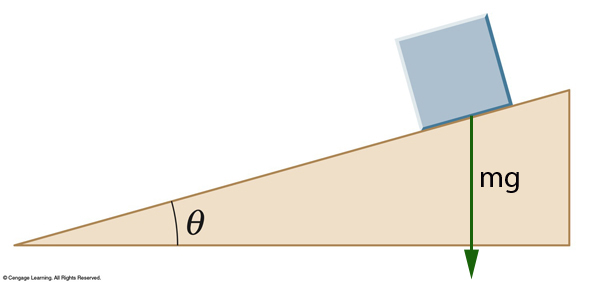
The weight of the object pulls it towards the center of the Earth (mg)
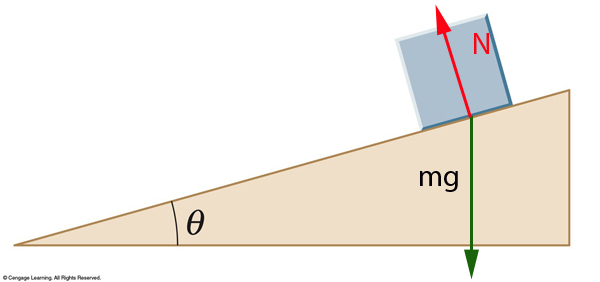
The object cannot accelerate towards the center of the Earth due to the ramp pushing up against that object. The upward push against weight is called the normal force.
We can now draw our force triangle (sorry about the yellow font!)
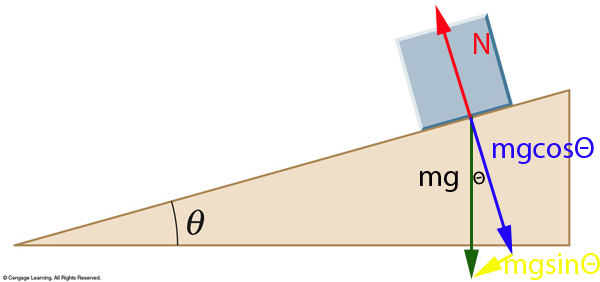
There's a lot going on here but notice that friction ALWAYS works against the acceleration of the object down the ramp

═══════════════════════════
Now let us return to a simple situation to explore friction further:
What exactly is friction anywho? (Please discuss)
Answer → aAlthough some objects are smoother than others, on a small, small scale almost all objects have little pits, valleys, bulges and other anomalies that tend to catch and snag as they slide against another object which hs its own pits, valleys and bulges.

The degree to which that two objects catch and snag against each other is called 'friction' and that can (and is) measured.
Remember, friction only works AGAINST motion it can never increase velocity.
A very helpful and detailed explanation can be found HERE
We can determine the frictional force between two objects as:
f = μN
(friction is FUN... get it?)
The greek letter mu (pronounced "mew") (μ) is called the "coefficient of friction" and is a measured quantity determined by material scientists and engineers.
So, let's get back to our previous problem but this time, let's say the box has a coefficient of friction with the ramp of .55
- Draw that situation using force triangles
- Do a SOTFA for that situation
- Find the acceleration of the object down the ramp (if any!)
Next Practice:
We have an 11 kg object on a ramp with an angle of 62 degrees to the horizontal. We'll ignore friction for the moment.
- Draw that situation using force triangles
- Do a SOTFA for that situation
- Find the acceleration of the object down the ramp.
Now let's say the object has a coefficient of friction of .33
- Draw that situation using force triangles
- Do a SOTFA for that situation
- Find the acceleration of the object down the ramp (if any!)
PRACTICE HANGER PROBLEMS
1) Practice "gentle" Varsity Problem
Start by assuming the object is at rest.
A 2.55 kg object is suspended by two wires. T1 pulls up and to the left at an unknown angle to the horizontal. T2 pulls up and to the right with a force of 19.52 N at an angle of 17.2 degrees to the horizontal.
Sketch that situation
Now please find the force T2 and the angle it makes to the horizontal.
My solution is HERE (page 1) and HERE (page 2)


Now please double check your work, do the up-pulling forces balance with the down-pullers?
Do the left pullers balance with the right pullers?
PRACTICE ELEVATOR PROBLEMS
1) C - Team:
You (mass 55.55 kg are in an elevator accelerating upward at a rate of 3.33 m/s/s. Your standing on a trusty bathroom scale. What does it read during that time)
My solution is HERE

PRACTICE RAMP PROBLEMS
1) Varsity:
A 7.5 kg aluminum box is placed on a steel ramp. Find the acceleration down the ramp (if any) if the coefficient if friction between aluminum and steel is .62
My solution is HERE

MORE Assorted Problems are found HERE